The Loudest Critic in the Room Is Usually Standing in Your Shoes
The Heckler You Can't Kick Out
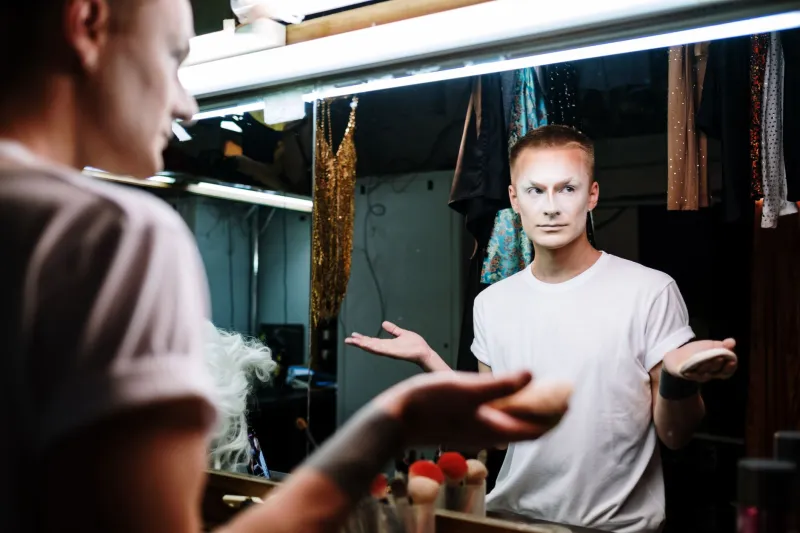
Most performers have dealt with a tough crowd at some point. A disengaged audience, a skeptical room, the occasional person in the third row who's clearly checked out. Those situations are uncomfortable, sure. But there's a trickier heckler most artists never talk about in interviews — the one living rent-free inside their own head.
Self-doubt is almost universal among creative people. The interesting thing isn't whether it shows up. It's what you do with it when it does.
The artists who last — the ones who keep stepping into the spotlight year after year — aren't the ones who never feel nervous or uncertain. They're the ones who've figured out how to stop treating self-doubt like it has backstage access.
Useful Nerves vs. the Kind That Wreck You
There's actually a meaningful difference between the anxiety that sharpens you and the kind that shuts you down. Performers who've been in the game long enough learn to tell them apart.
The productive version feels like alertness. Your senses are heightened, you're tuned in, your body is ready to move. Athletes call it being "in the zone" before the zone even starts. For a performer, it's that electric awareness right before the curtain rises — the kind that makes you better, not worse.
The destructive version sounds more like a loop. What if I forget the words? What if they don't connect with this? What if I'm not actually as good as people think? That's not nervous energy — that's your inner critic grabbing the microphone and refusing to give it back.
The reframe that many performers rely on is surprisingly simple: treat nerves as evidence that something matters. The moment you stop feeling anything before a performance is probably the moment you've stopped caring. Anxiety, reframed, becomes proof of investment.
The Mental Rituals Nobody Posts About
We hear a lot about physical pre-show routines — vocal warmups, stretching, specific playlists. But the mental side of preparation is where the real heavy lifting happens, and it's far less Instagram-friendly.
Some performers use what psychologists call "implementation intentions" — basically, mental rehearsals where you walk yourself through not just the ideal scenario, but the recovery from a stumble. You don't just imagine nailing it. You imagine hitting a rough patch and finding your footing anyway. That kind of mental rehearsal builds a kind of psychological muscle memory that pure confidence-boosting affirmations often can't.
Others use what's sometimes called "distanced self-talk" — referring to yourself in the third person when you're coaching yourself through doubt. It sounds strange, but research out of the University of Michigan suggests it actually creates enough psychological distance to quiet the emotional noise. Instead of "I don't know if I can do this," it becomes "David can handle this — he's done harder things." The slight detachment changes the whole tone of the internal conversation.
And then there are the performers who've learned to simply acknowledge the doubt without arguing with it. Rather than trying to convince themselves they're not nervous, they say, out loud or internally, "Yep, I'm nervous, and I'm doing this anyway." That's not bravado. That's actually a more honest and effective move than pretending the fear isn't there.
The Gap Between Private and Public
One of the most disorienting things about performance — whether you're an artist, a public speaker, a teacher, or anyone who regularly has to show up fully in front of others — is managing the gap between how you feel privately and how you need to appear publicly.
That gap isn't hypocrisy. It's professionalism.
Confidence, at its most functional, isn't the absence of doubt. It's the decision to act despite it. The performer who walks onstage with butterflies in their stomach and delivers something genuine isn't faking it — they're doing something much harder than faking it. They're choosing presence over paralysis.
What makes this tricky is that self-doubt has a way of disguising itself as wisdom. It whispers things that sound reasonable: maybe now isn't the right time, maybe I need more preparation, maybe I'm not ready. Sometimes those whispers are worth listening to. But more often, they're just fear wearing a sensible blazer.
The skill — and it is a learnable skill — is knowing the difference between genuine unreadiness and the anxiety that shows up specifically because something matters.
What Everyday People Can Steal from This
You don't have to be a performer to deal with this dynamic. Anyone who's ever had to give a presentation, lead a difficult conversation, ask for a raise, or show up authentically in a high-stakes moment knows the feeling.
Here's what translates directly:
Stop trying to eliminate doubt before you act. Waiting until you feel fully confident is often just a sophisticated form of procrastination. The confidence usually comes after the action, not before it.
Build your own pre-game ritual. It doesn't have to be elaborate. Even a few minutes of deliberate mental preparation — reviewing what you know, reminding yourself of past moments you navigated well, breathing with intention — can shift your internal state enough to matter.
Separate your performance from your identity. This one's huge. When self-doubt gets truly destructive, it's usually because it's crossed a line from "I might not do this perfectly" into "I might not be enough." Those are completely different conversations. One is about execution. The other is existential. Keeping them separate is one of the most important mental moves a performer — or anyone — can make.
The Audience That Actually Matters
Here's the thing about that inner critic: it's not actually trying to protect your reputation. It's trying to protect you from the discomfort of trying and falling short. That's a very different motivation, and once you see it clearly, it loses a little of its authority.
The most meaningful performances — the ones that actually connect with people — rarely come from a place of certainty. They come from a place of commitment. The willingness to show up fully even when the internal weather is rough. That's not superstition. That's not luck. That's just the work.
And it turns out, doing that work quietly, consistently, and without needing anyone to witness it? That's where real confidence actually gets built.